
Introduction
WHEN THE KING WALKED IN UNNOTICED — AND LEFT BEHIND A LESSON NO PRICE TAG COULD MEASURE
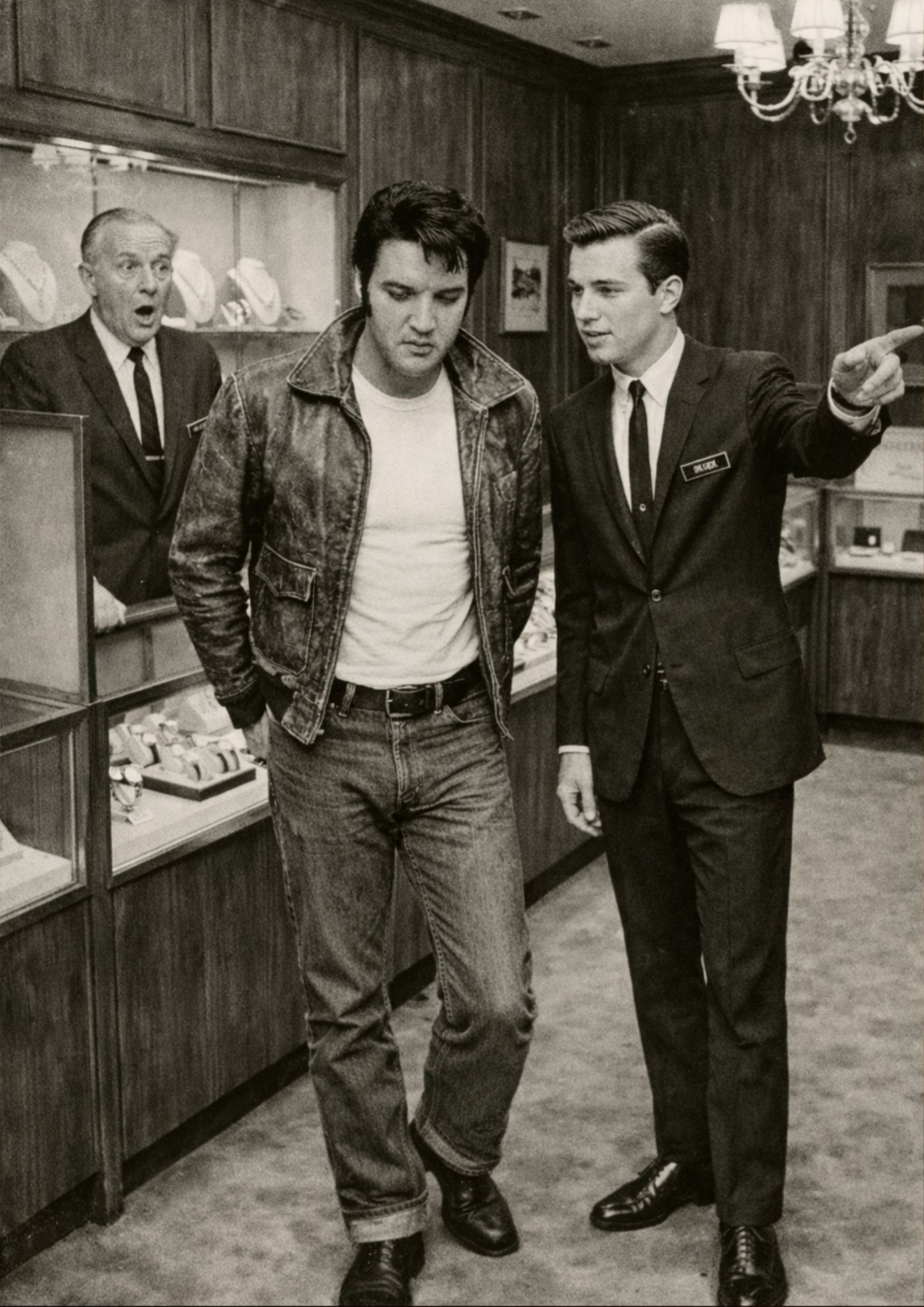
It was a quiet afternoon in Memphis—one of those slow, reflective hours when the world seems to pause just long enough for something meaningful to unfold. Inside a refined jewelry store, soft lighting shimmered across glass displays, illuminating rows of gold and gemstones that whispered of elegance and wealth. The atmosphere was calm, almost sacred, as though every object carried a story waiting to be chosen.
Then the door opened.
In walked a man who, at first glance, seemed almost ordinary. Blue jeans. A black T-shirt. Sunglasses resting casually on his face. Nothing about him demanded attention. Nothing announced that this was Elvis Presley—a man whose voice had once shaken arenas and whose presence had redefined American music. At thirty-six, he carried fame that few could comprehend, yet on this particular afternoon, he was not seeking applause. He had come for something quieter. Something deeply personal.
He was there to find a gift for Priscilla Presley.
Not something extravagant. Not something meant for headlines. But something meaningful—an emerald necklace, chosen not for its price, but for its quiet beauty. A gesture that said, in the simplest way, I still care.
Elvis approached the counter slowly, his eyes drawn to the deep green stones beneath the glass. Emeralds—rich, steady, timeless. They did not shout for attention. They simply were. Much like the feeling he wished to express.
But behind the counter stood a young salesman who barely looked up.
Perhaps it was the casual clothes. Perhaps it was the absence of entourage or spectacle. Whatever the reason, the man saw not a legend, but a stranger he quickly judged. With a faint smirk and a dismissive tone, he spoke words that cut through the stillness of the room.
"These pieces start at fifteen thousand dollars," he said. "Maybe try the cheaper section."
For a moment, everything seemed to stop.
The words hung in the air—heavy, unmistakable. And in that silence, something stirred within Elvis. Not anger, not pride—but memory. Memories of Tupelo. Of modest beginnings. Of doors quietly closing before he had the chance to prove who he was. He had lived this moment before, long before the fame, long before the lights.
And yet—he did not react.
He did not raise his voice. He did not correct the man. He simply stood there, calm and composed, as if the moment did not require defense, only patience.
Then, quietly, the scene shifted.
From the back office, the store manager stepped forward. Unlike the salesman, he looked more closely. Recognition came not gradually, but instantly. His expression changed in a heartbeat—eyes widening, posture tightening, as realization took hold.

This was not just any customer.
This was Elvis Presley.
The room fell into a different kind of silence now—the kind that arrives when a mistake becomes undeniable. The young salesman's face lost its color as understanding dawned. What had been said could not be taken back. What had been assumed could not be undone.
And in that moment, Elvis had every reason to respond.
He could have spoken sharply. He could have exposed the young man's mistake in front of everyone. With a single sentence, he could have turned embarrassment into humiliation. His name alone carried that power.
But he chose something else.
He chose dignity.
Without a trace of anger, Elvis simply continued. He returned his attention to the emerald necklace, speaking calmly with the manager, asking questions, making his decision as though nothing had happened. There was no lecture. No correction. No attempt to prove anything at all.
He completed the purchase quietly.
And then he left.
No headlines. No photographers. No grand moment captured for history. Just a man walking out of a store, leaving behind something far more valuable than the jewelry he had purchased.
Because in that brief encounter, the young salesman learned a lesson no training could teach.
He had judged a man by his appearance—and been met not with retaliation, but with grace.
And that is where the true story lives.
For all the power Elvis held on stage—the voice, the charisma, the command over thousands—this quiet moment revealed something deeper. Something rarer. The ability to remain humble when pride would have been easier. The strength to choose restraint when reaction would have been justified.
It is often said that greatness is measured by what a person does when the world is watching. But perhaps the truer measure lies in what they do when no one is.
On that quiet afternoon in Memphis, there was no audience. No applause. No spotlight.
And yet, in that silence, Elvis Presley showed exactly why he was more than just a legend.
Because sometimes, the greatest power a person can possess is not in proving who they are…
…but in reminding others to look again.