
Introduction
The Night the King Returned: Inside Elvis Presley's Quiet Moment Before Changing Everything Again

August 1969 did not simply mark another date on the calendar for Elvis Presley. It marked a return that carried the weight of expectation, doubt, memory, and possibility all at once. After nearly a decade away from live performances, the man once crowned the King of Rock and Roll was preparing to step back onto a stage—not just any stage, but the showroom of the International Hotel in Las Vegas, filled with more than two thousand people waiting to see if the legend they remembered still existed.
For years, Elvis had remained present in the public eye through films and recordings, yet something essential had been missing. The stage—where his energy, charisma, and connection with an audience once reshaped music itself—had been absent from his life. And now, as he stood on the edge of returning, the question was not only whether he could still perform. It was whether he could reclaim that unspoken bond with a live audience, the kind that cannot be rehearsed or manufactured.
Behind the curtain, just moments before the performance, there was an unexpected stillness.
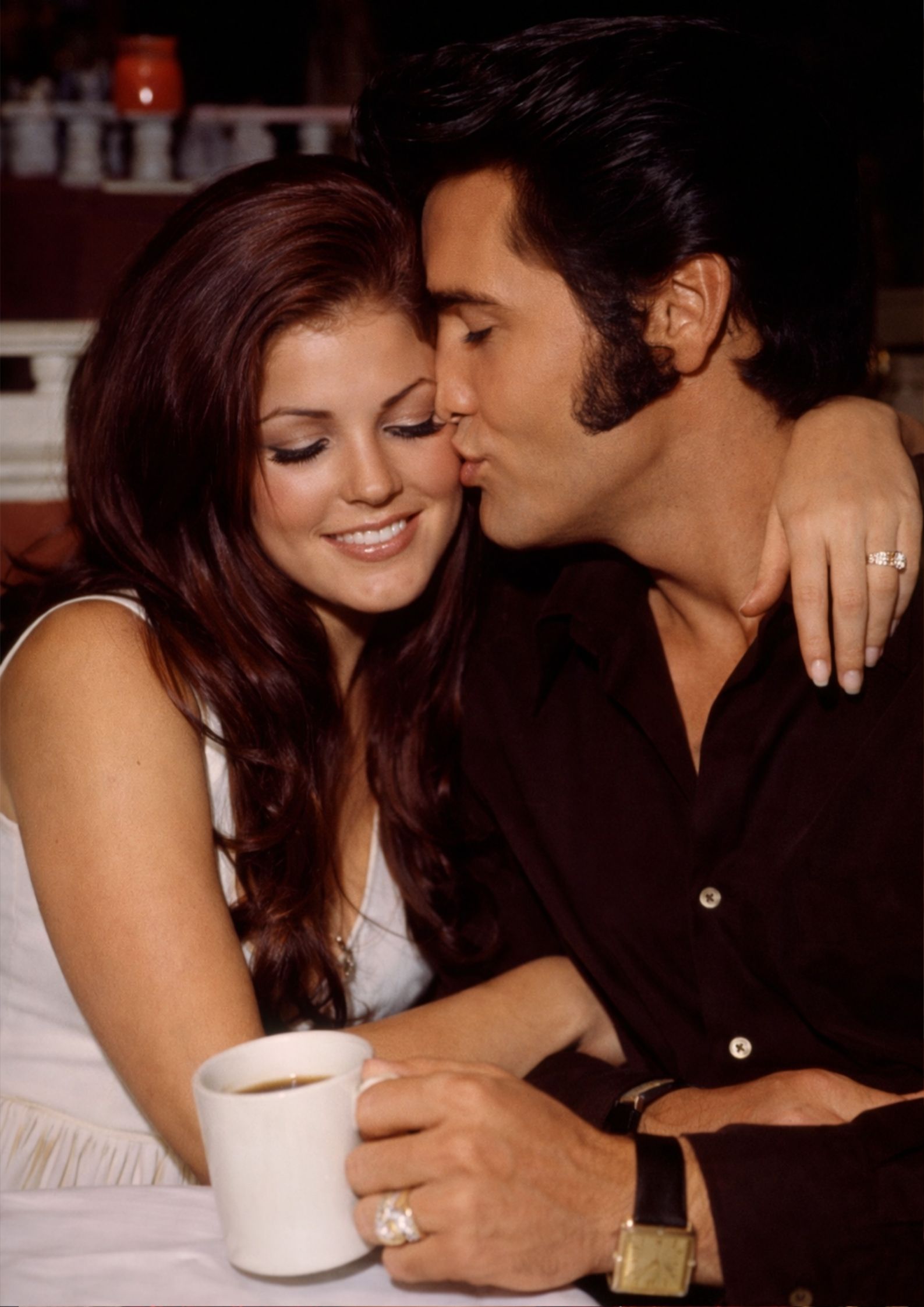
Sitting beside him was Priscilla Presley, the person who had witnessed both the height of his fame and the quieter, more uncertain years that followed. In that space, removed from the roar of the crowd, Elvis was not the larger-than-life figure seen by millions. He was a man in reflection, carrying the awareness that this night could redefine his future.
There were no cameras in that moment. No headlines. No performance.
Just silence.
Priscilla would later recall the intensity of his focus, the way he seemed to withdraw inward—not out of fear, but out of deep concentration. This was not a casual return. It was a test, one he had set for himself. After years away from the stage, he understood that the world would not simply welcome him back without question. He would have to earn it again.
And that realization made the moment human.
For all the grandeur associated with Elvis Presley, there was always a man beneath the image—a man who cared deeply about how he was received, who understood the importance of connection, and who knew that true performance was not about spectacle alone, but about presence. That quiet moment before stepping into the lights reveals something often overlooked: even legends experience uncertainty. Even icons pause.
When he finally walked onto the stage, everything changed.
The response from the audience was immediate and overwhelming. Applause surged through the room, not just as recognition, but as anticipation. People leaned forward. They watched closely. They waited to see whether the voice, the movement, the undeniable magnetism they remembered would return with him.
It did.
From the first notes, Elvis did not simply perform—he reintroduced himself. There was a renewed energy in his delivery, a sharper focus, a deeper emotional engagement. He moved with confidence, sang with conviction, and held the audience in a way that felt both familiar and newly powerful. It was not a repetition of past glory. It was a reinvention rooted in experience.
Song after song, the room responded—not with polite appreciation, but with genuine excitement. Something had shifted. The uncertainty that lingered before the performance gave way to recognition. The King had not faded. He had evolved.
That Las Vegas residency would go on to become one of the defining chapters of his career, spanning hundreds of shows and reestablishing him as a commanding live performer. It was more than a comeback. It was a reaffirmation of identity.
Yet what makes this moment endure is not only what happened under the spotlight.
It is what happened before it.
That quiet exchange—or perhaps more accurately, that shared silence—between Elvis and Priscilla remains one of the most revealing glimpses into the man behind the legend. In that space, there was no performance to rely on, no audience to respond, no music to carry the weight. There was only preparation, reflection, and the understanding that everything about to happen depended on what came next.
For older audiences who have lived through moments of change, reinvention, and quiet uncertainty, this scene carries a particular resonance. Life often asks us to step forward again after periods of doubt, to stand once more in places we once felt certain in, and to prove—not to others, but to ourselves—that something essential still remains.
That is what Elvis faced that night.
And that is why the story continues to matter.
It reminds us that even the most celebrated figures must, at some point, begin again. Not with certainty, but with courage. Not with noise, but with a single step forward.
In the end, the return of Elvis Presley in August 1969 was not just a triumph of performance. It was a triumph of resolve. It showed that greatness is not only defined by how high someone rises, but by how they return when the moment demands it.
And before the lights, before the applause, before the music filled the room—there was a man sitting quietly beside someone who knew him best, taking one last breath before stepping into history once again.