
Introduction
"IT FELT LIKE HE WAS STILL THERE" — THE NIGHT PRISCILLA PRESLEY TURNED A SONG INTO A MEMORY THAT WOULDN'T LET GO
There are performances you watch.
And then there are performances you feel—the kind that seem to reach through the screen and settle somewhere deep, where memory and emotion quietly live side by side.
What happened that night was not just another television moment.
It felt like something older.
Something sacred.
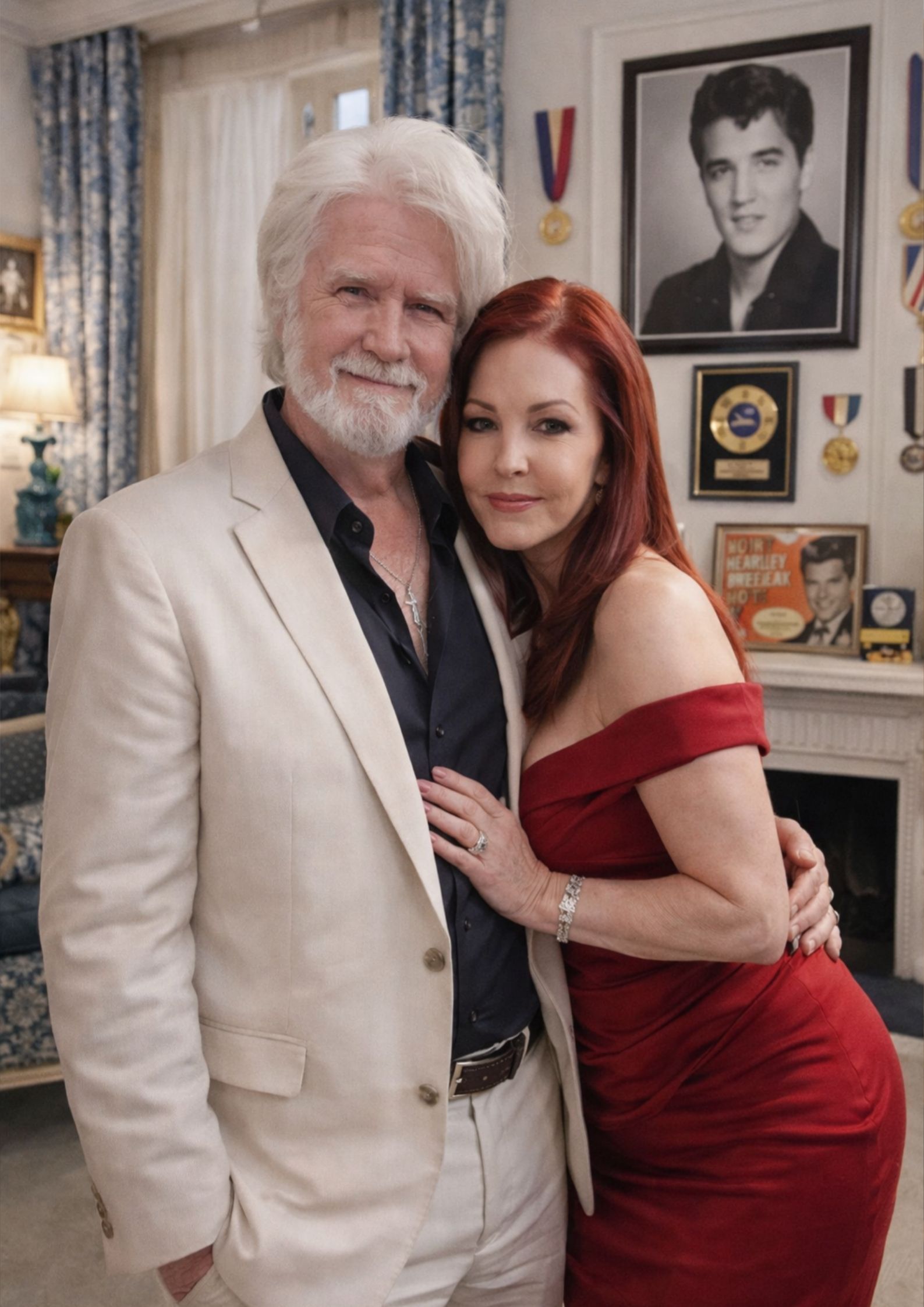
When Priscilla Presley stepped into the light, the room changed before a single note was sung. There was no need for a grand introduction. No need for buildup. Her presence alone carried the weight of a lifetime—of love, of loss, of a man whose voice has never quite left the world.
And for many watching, especially those who remember when Elvis Presley first changed everything, the moment felt personal before it even began.
Then, quietly, Bob Joyce stepped beside her.
No spotlight shift.
No dramatic entrance.
Just a man, a woman, and a song that has outlived generations.
"Can't Help Falling in Love."
From the very first notes, it became clear this would not be a performance built on imitation or spectacle. There was no attempt to recreate Elvis's voice, no effort to match the grandeur of past renditions. Instead, what unfolded was something far more powerful—and far more difficult to achieve.
Restraint.
Reverence.
Truth.
Bob Joyce's voice rose first—steady, warm, and unhurried. It didn't try to command the room. It invited it in. And when Priscilla joined, her delivery was not that of a performer trying to impress, but of someone remembering. Each word felt closer to a whisper than a declaration, as though she were not singing to an audience, but speaking across time.
Their voices did not compete.
They met.
Gently.
Carefully.
As if both understood that the song itself carried more meaning than anything they could add to it.
And in that understanding, something remarkable happened.
The room fell completely still.
You could see it in the audience. People who had come expecting a tribute suddenly found themselves inside something much deeper. Hands lifted slowly to faces. Eyes filled. Couples leaned into one another without thinking. Some mouthed the lyrics softly, while others simply watched, unwilling to break the fragile atmosphere that had settled over the space.
Because this was no longer just music.
It was memory, made visible.
Every line—"Take my hand, take my whole life too…"—landed with a quiet force that no grand vocal could have delivered. For those who had lived long enough to know what it means to love, to lose, and to carry both at once, the song became something almost unbearably real.
Viewers would later say it felt as though Priscilla Presley was not performing at all.
She was remembering.
And in doing so, she allowed millions of others to remember with her.
Beside her, Bob Joyce held the moment with a kind of humility that only strengthened its impact. He did not try to become Elvis. He did not step forward to claim the spotlight. Instead, he supported the space the song needed—lifting it, steadying it, and allowing it to breathe.
That choice mattered.

Because it kept the focus exactly where it belonged.
On the feeling.
On the history.
On the unspoken presence of the man whose voice once carried those same words.
As the duet moved toward its final lines, something almost physical settled into the room. The kind of silence that doesn't feel empty, but full. You could hear the faint shifting of people in their seats, the quiet intake of breath, the subtle awareness that this moment—whatever it was—would not easily be repeated.
And then, the final words came.
"I can't help falling in love with you."
They lingered.
Hung in the air.
And for a brief, unforgettable second—
Nothing happened.
No applause.
No movement.
Just stillness.
It was as if the entire room needed time to return to itself.
And then, almost all at once, the emotion broke through.
The audience rose.
Not gradually, but together.
A standing ovation that felt less like celebration and more like release. Hands clapped, yes—but some trembled. Others simply remained at their sides, as people stood with tears in their eyes, trying to process what they had just experienced.
On television screens across the country, similar scenes unfolded. Living rooms fell quiet. Conversations stopped. Viewers reached for tissues, not because they expected to be moved, but because something had reached them without warning.
Social media would later call it "spine-chilling," "holy," "like Elvis was in the room."
But perhaps those words, as powerful as they are, still fall short.
Because what happened that night was not about bringing Elvis back.
It was about reminding people why he never truly left.
In the final moments of the broadcast, as cameras lingered on Priscilla lowering the microphone—her expression calm, reflective, almost private—and Bob Joyce offering a quiet nod, there was a sense that something had been completed.
Not performed.
Not recreated.
But honored.
This was not a gimmick.
It was not a spectacle.
It was a bridge—fragile, beautiful, and deeply human—stretching between past and present, between memory and presence, between the man the world still calls "The King" and the people who continue to carry his voice forward.
And for those who witnessed it, whether in the room or through a screen, one thing became clear:
Some songs do not belong to a moment.
They belong to a lifetime.
And sometimes, if the moment is right, they return—not louder, not bigger, but deeper than ever before.
As if to remind us that the things we truly love never disappear.
They simply wait—
Until we're ready to feel them again.